Showing posts with label seeds. Show all posts

Sunday, March 20, 2011

Stray Not, Thy Wandering Heart: This Year’s Seed Order

Last year, I purchased some yellow wax pole bean seeds and other vegetable seeds from another catalog. I felt somewhat guilty betraying John Scheepers Kitchen Garden Seeds, since they were the first and best source when my more serious ventures in suburban agriculture started a few years ago. Midway through last season, I asked myself, “Why did I ever stray?”

The company is based in Connecticut, a neighboring state, so I can keep my dollars somewhat local. The catalog never fails to satisfy in both its charm and information. But, more importantly, the seeds are flat-out great. Some three-year-old Scheepers seeds I used last year had better germination rates and heavier vegetable production than the new ones I purchased from the other source. Suffice it to say, save some collard greens from the 4/$1 seed stand at my grocery store, just about everything going in the ground this year will be from Scheepers.

And (drum roll please…) the new purchases are:

Winter Red Russian Kale
Purple Dragon Carrots
Lemon Cucumbers
Zucchetta Trombolina Zucchini
Purple Podded Pole Beans (a perennial favorite)
Both red and yellow “jellybean” grape tomatoes
Sungold cherry tomatoes
Lyn’s Mahogany Garnet tomatoes
Persimmon tomatoes
Australian Butter Squash (for winter storage)

I’m especially excited about the new squash. Winter squashes have done quite well in my yard in years past and (I pray I’m not jinxing it here) I hope this new variety will do just as well and pleasantly surprise with its flavor and storage potential. The Australian Butter Squash is described as a “pumpkin-shaped heirloom, prolific, tasty and versatile with a pale, buff-orange hard shell and sweet, dense orange flesh with a small seed cavity…Weighing in at 12-15 pounds, list long-keeper may be stored and used throughout the winter.”

The areas for my cool-weather crops are turned over and ready, so the following will be planted shortly: the new red kale, Tuscan Lacinato Kale (older seeds, still viable), collard greens, and various lettuces. In a few weeks, the carrots and some parsnip seeds (not yet purchased) should make their way into sweet Mother Earth.

So, with seeds about to go in the ground, I may as well start the Eco-Nomics of it all for the 2011 growing season:

Scheepers Order: $37.15
Collards, w/tax $ 0.27
Total: $37.42

I have peat pellets left over from last year, along with their reusable growing trays and some seed starting mix. My daughter and I will start our tomato seeds shortly. Most everything else will be directly sown. We’ll keep you posted.

Wednesday, April 14, 2010

Starting Seedlings

We started our first seeds of the season indoors this weekend, and had our first “incidents” of the season within 24 hours.

My daughter and I on Saturday morning finally got around to sowing tomato seeds in a peat-pellet tray. The excitement and anticipation never disappoints, as she completely took over once we commenced operations at the kitchen counter. More skilled this year than last, she soaked the pellets, inserted the first tiny seeds into the swollen peat balls, then moved onto the next variety – without assistance or instruction from me. She became somewhat upset when I offered help!

In addition to the tomato seeds, we made a row of six sunflower seeds, which came from a packet given to her last year by my best friend. I’m excited about these, as they are not the “usual” yellow sunflowers. We grew those giants last year with great results, but these flowers come in mixed autumnal tones that should be rich, deep and dark.

We placed the covered tray near a sunny window, and no sooner did our cat Daisy lay atop it, crush the cover, and settle into the depressed “bed” that surrounded her. Not good.

The next morning, I awoke to find the tray overturned and on the floor, with peat pellets in piles. Not good either. I could barely tell if the seeds were still in the soil, much less discriminate between the tomato pellets and the sunflower pellets. That will be more apparent when they sprout, but until then, I need to keep an eagle eye on the tray. Remember that last year, Maisy clipped most of my celery root seedlings along with some others. And once fallen, the cats like to bat around the ball-shaped swollen pellets like toys, leaving looping trails of dirt and flakes of peat in their wake.

The tray is secured shut with a rubber band now and moved to a different window. We’ll keep you posted.

What We’re Growing this Year:
Pole Beans: Yellow Wax, Kwintus Beans, Emerité Filet Beans, Purple Podded pole beans
Summer squash: white and mixed-color pattypan; mixed color eightball zucchini
Winter squash: Butternut, Delicata
Red, White and Purple Potatoes (which we’ll buy and sprout in the coming weeks)
Tomatoes: Black Cherry, Sun Gold Cherry, Black Russian, Husky Gold and a red tomato from seeds given by a friend’s Polish Godmother.
Dwarf bok choy
Lemon Cucumbers

What’s in the Ground Now:
Rhubarb and Bright Lights Swiss chards
Mesclun mix, Mache, Radicchio
Tuscan Lacinato Kale
Sugar Snap Peas
Golden Beets

What I’ll Pick-up at the Nursery after the Last Frost Date:
Either Rosa Bianca or White Eggplant
Purple and Green Basil
Kirby Cucumber plants
Maybe a Roma and/or Big Boy tomato plant or two

Whatever I purchase will be included in this year’s Eco-Nomics, which so far is pretty low.

Tuesday, April 6, 2010

Early Beginnings

The farm has begun.

Tuscan kale, sugar snap peas, rhubarb Swiss chard, rainbow Swiss chard, a row of golden beets and wide patch of baby lettuces are all in the ground. Save the $1.19 mesclun mix, every seed was left over from last year or the year before. They’re still viable, and coming up.

When I purchased the mesclun seeds early last month, I had to exercise some restraint. When we see the first seed stands of the season, my daughter and I both become wide-eyed and energized. I’m like a kid in a candy store – full of hope for the growing season to come. Then we’ll bounce from store to store to see if other seed stands are up and running. She just goes insane, picking packet after packet until they spill out of her little hands. “Let’s grow this!” “Can we grow corn?” “I want the carrots again!”

Ah, that “again.” I knew we had some red carrot seeds from last year, but hadn’t taken a full seed inventory and didn’t remember precisely what I had on hand. We bought just the mesclun mix (with one of us leaving the store moping) then headed home to check our stock.

We had just about everything in the quantities needed for a good harvest. We did not, however, have enough varieties to fill all of the beds. I want to try more “storable” items for winter, like squashes, maybe parsnips and definitely more potatoes than I did last year. I also wanted a few different summer crops, specifically yellow wax beans.

My favorite catalog, John Scheepers, had only a bush variety. Plus, all the seeds I’m re-using this year are Scheepers seeds. Should I forsake them for a different company? I did: Jung Seeds had a climbing wax bean, “Kentucky Wonder,” so my daughter and I and I built an order around it.

Along with the pole beans, we chose mixed color eight ball zucchini, mixed pattypan squash, mache (or lamb’s ear lettuce) and dwarf pak choi.

The baby bok choy was an impulse at the end – a good one, I hope. It’s easy to grow and quick to harvest. And we like vegetarian stir-fries in this household.

The seeds haven’t come yet … I’m getting a little worried. The time for planting the mache will soon pass.

So, with seeds in the ground and more on the way, I may as well start the Eco-Nomics for the season:

Mesclun seeds $ 1.19
Jung Seeds $16.12
Total: $18.31

Inventory also went beyond seeds. I have peat pellets left over from last year, along with the reusable growing trays and half a bag of seed starting mix. My daughter and I will start our tomato seeds this week.

Tuesday, January 5, 2010

A Girl Can Dream, Can't She?

Plant, plant, plant your seeds
Neatly in a row
Merrily, Merrily, Merrily, Merrily,
Don’t forget your hoe!

My first garden catalog
Came by mail today
Seeds and vines and roots and herbs
I can’t wait ‘til May.

We won’t wait ‘til then
You know just what I mean
Seedlings started extra early
Will deliver green.

Heirloom tomatoes, climbing beans
Seed potatoes – Wow!
Purple basil, baby squash
I can nearly taste them now.

But first I have to narrow down,
From a thousand items all told
I want them all, I can’t decide
This winter has been so cold.

But spring will dawn, my beds will thaw
My robin will make the scene
But until that day, I’ll close my eyes
And all I’ll do is dream.

Friday, July 17, 2009

Eco-nomics: Harvest


It’s payback.

So far, I’ve harvested four armloads of Swiss Chard, and I’m not kidding about the word “armloads.” Holy mackerel. I’ll conservatively put each at $2.50, considering what $1.29/lb gets you at my supermarket. Some baby leaves have been making their way into salads all along. The chard is also just unbelievable: the colors are so bright, so varied and the volume speaks for itself. Just like “Cannoli 18 Ways,” I’m on my way to writing “Chard 118 Ways.” I love it, as does Mike, but we’re nearing overload. The next bale of greens has my father’s name on it.

I’m also up to my ears in cucumbers, which seem early to me this year. We’ve picked at least a pound of kirbies, which barely make it to the table. My daughter eats them straight off the vine – she goes hunting for them, actually. I’m glad I tried something new this year and planted them! The lemon cucumbers are coming in like gangbusters. I’ve picked a few here and there, but come next week, there are at least a dozen that will be ready. Each time I look at the vines, I can’t believe my eyes. I’ll tally those at that time.

The little filet beans are early producers, and at least a pound have come off the vines. They are delicate and sweet, and even the ones that elude us and grow too long are super tender as well. A lot of these little beans go into a pound. If I let them grow larger, the harvest weights would be higher. But I grew these to be picked small. Next time I come into some good tuna steaks, a salad nicoise will be in order, and especially when my fingerling potatoes are ready in the fall.

A big surprise is the Kwintus pole beans. I was not expecting these to come in so early, but MAN – do those vines produce! The beans also grow fast. Those left on the vine for an extra day jump out at you the next, reaching eight inches seemingly overnight. And even at that length with a 1” width, they are tender and stringless – excellent cut on a diagonal and steamed, sautéed or tossed into a hot sausage and peppery pasta dish like the one I made last week for my husband. The beans keep their crunch and their color beautifully when cooked. Plus, we’re up to almost 2 lbs picked. I gave a bag of them to my parents this weekend, with rave reviews when they cooked them. I’ve never seen these at the store, so I’ll just price them as regular green beans, which are $1.29/lb lately.

Volumes of tender green small leaf lettuce along with two very large heads of red loose leaf lettuce have created some great salads. I would easily have spent more than $4 for this at the store – quite a nice return on that impulse buy of two 20-cent seed packets! I can’t wait to plant more in the fall. The lettuces are in pots, so the rabbits haven’t marauded them. The same can’t be said for my four heads of cauliflower. Only one made it to full size and to the table.

We’ve also pulled a few red carrots, but I feel they need a bit more time in the ground. The one pattypan squash picked made its way to the grill – de-lish. Neither is really enough to tally right now, so I’ll omit them.

So, here goes, the first Eco-nomics Harvest Tally:

Chard: 4 @ $2.50= $10.00
Kirby Cukes: 1 lb @ $.99/lb (Shop Rite price)= $.99
Haricot Verts: 1 lb @ $2.49/lb= $2.49
Kwintus Beans: 2 lbs @1.29/lb = $2.58
Lettuces: $4.00
Cauliflower: $1.50
Total Harvest so far: $21.56

Total Expenditures: $49.70
Less Harvest: $21.56
Balance: $28.14

I’m still in the red, so to speak, but we’re getting there. And pretty far along at that.

Thursday, June 4, 2009

June is Bustin’ Out All Over

Bustin’? Well, that remains to be seen. But at least it’s off to a good start. Sprouts are sprouting, plants are planted and vines are twining. But my level impatience this year seems higher than ever, if that’s even possible. Here we go, from bed to bed, front to back:

The patch of corn with sunflowers rising in the background is off to a good start. I staggered the planting this year in hopes that the harvest will be spread out over a few weeks.

Red carrots and Swiss Chard varieties are clipping along in the small bed that lies astride the garage. Christmas lima beans and Kentucky Wonder green pole beans are planted to climb the trellises we built last year. It’s hard to believe this small bed used to be my sole planting area.

Lettuces are growing pots, as is my thyme plant. I moved my radicchio to one of the pots from a ground bed due to rabbits. The thyme will be planted on the rim of the main beds, along with a division of my oregano, when I both remember to do it and find time. An impossible combination.

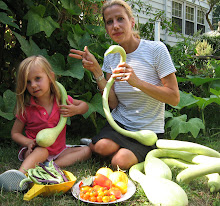
Squash bed (1st/smallest): Winter squashes in alphabetical order from front to back, Buttercup, Butternut and Delicata. The last, large double-mound contains pattypan squash. Three climbing Zucchetta Trombolina plants are near the rhubarb in a corner of the yard.

Middle bed: Lemon cucumbers and Kirby cukes are ready to climb the staked twine. The kirbies also have flowers.

Tomatoes: Area is packed full, but plants are small. Why? I have no idea. The soil was pre-warmed, which made them shoot up and produce early and prolifically last year. But considering the size of the plants, I think I could have just skipped the mess, series of incidents and ensuing drama of starting them indoors and instead, direct-sowed the seeds with the same plant size resulting. Such is life. It’s only the first week of June. There’s time. I like to think each little tomato plant is developing a huge set of roots underground, where I can’t see. I attempted to plant them in backwards-alphabetical order starting with “Y”, but that lasted for only 1-½ rows. When I planted the Black Cherry tomatoes (or Black Russian?) before the Sungold Cherries, I wasn’t about to take them up and start over. I figured I’d just remember which was which. [What was I thinking?] I know where the heirloom yellows and two San Marzanos are. The rest will tastily surprise.

The largest bed starts with watermelon radishes and four cauliflowers. Believe it or not, the three little ones have white cauliflowers growing inside – at a competitive size with that of the large-leaved plant. Behind those, you’ll find the beets. No, I don’t see them either. I have a confession to make: I’m an inveterate bad-waterer. Notice the soaker hoses I bought and put down just this weekend. Thought it was about time. A top dressing of composted leaf humus will be the finishing touch.

Yellow bell peppers, one purple pepper and Rosa Bianca eggplants doing all right. Common basil and lettuce leaf basil in the center of that bed. You’ll also see four celery plants, which I purchased for $2 at the farmer’s market. They don’t count toward the running total, or to the harvest tally. It would be impossible to calculate, since I pick the celery constantly and the stalks regenerate themselves during the summer. It’s a terrific thing to grow for that purpose, since I only need a stalk or two for a grain salad or other dish, hardly ever an entire bunch. Also, hot chili peppers – a pair of plants I found at that bastion of green, the Home Depot. I found a pot that had two tall, strong plants, so I couldn’t resist. My dad (and father-in-law for that matter) can’t wait for them.

Pole beans are also planted in alphabetical order from front to back: Emerite filet, Kwintus and purple-podded. I love garden beans. They’re easy and dependable. Just have your four-year-old poke her finger into the soil, drop the seeds in, and soon enough they’re all vining and twining their way up the poles. The three tee-pees will be just gorgeous once the plants fully cover them and start to flower.

Celery Root surviving. And …

Potatoes! Two russets and a fingerling plant. I can’t believe it! Those spuds I thudded into the ground came up! The plants are strong and actually quite attractive. I had chalked them all up for lost, since our black and white cat, Senor Wences, found the loose and deeply dug soil irresistible for digging and rolling. They truly appeared out of nowhere. The russets surprise me the most, since they were supermarket potatoes from a 5-lb bag, and were probably sprayed with an anti-sprouting agent. Two of two came up. The fingerlings came from potatoes purchased at Whole Foods, labeled organic, and I assume not sprayed with anything. Only one of three came up. Either way, the plants appear to be growing fast, and they are sturdy. I’ve never grown potatoes before and I’m excited to watch them.

Whew! That got long. Maybe June is bustin’ out all over.

Monday, May 11, 2009

Planting Party

It was a happy Mother’s Day. A crisp-breezed, blue-skied, birds-chirping, muddy, grubby, dirt-under-your-fingernails Mother’s Day.

We planted seeds and seedlings all afternoon.

The day started with a brunch at my mom’s townhouse and a stop on the way to purchase a floral hanging basket for her. My daughter and I went to a local nursery and farm where I also picked up a 4-pack of yellow bell pepper seedlings for $1.79. The plants looked terrific, and I’m happy to support that nursery and farm. It’s a small but longstanding business in competition with not one or two but three Home Depots in Bergen County, in addition to a Lowe’s that opened last year.

Plus, the excitement and prospect of planting them that afternoon made me stop by on the way back from my mother’s. I purchased a 4-pack of Rosa Bianca eggplants and a 3-celled pack of Kirby cucumbers that contained six plants.

Once home, my daughter and I got down n’ dirty, building the pole bean teepees and erecting a cucumber contraption we constructed from twine and some old garden edging we found in the shed. We cut holes in the plastic sheeting I’d applied weeks ago to pre-warm the soil, measured, dug, spaced, sowed, planted and watered for much of the afternoon, with, to my memory, just a few breaks: a game of tag, a change from soaked shoes to dry (hers), a change from a soaked dress to dry jeans (ditto), one stop to make a peanut butter and birdseed sandwich to fit into the suet feeder, another to make a peanut butter sandwich for the humans, the unraveling, re-raveling and unraveling yet again of the entire spool of twine, two glasses of pink lemonade, playing with the cats underfoot, an incident involving two bottles of bubbles – it’s a wonder we got so much done!

What’s in the ground now, coded with an S for “from seed” and a P for “purchased plant”:

Tuscan Kale and white cauliflower (S)
Watermelon radishes, Detroit red beets, golden beets (all S)
Radicchio (S) – my cats are not fending off the rabbits there.
Red Carrots, Rhubarb Swiss Chard & Rainbow Swiss Chard (all S)
One row of corn (S) – two more to come over the next two weeks.
Pole beans: Kwintus, Emerite Filet and Purple Podded (all S)
Winter squash: Butternut, Buttercup and Delicata (S)
Pattypan Squash (S)
Yellow bell peppers (P)
Rosa Bianca eggplants (P)
Lemon cucumbers (S)
Kirby cucumbers (P)

While we were at it, I tossed in three fingerling potatoes that had sprouted in the kitchen, plus a Russet that I cut in half and scabbed over. They went in just around the outer rim of the largest bed. We’ll see what happens there.

Tomato varieties (all S) and celery root (S) are going in soon. Zucchetta Trombolina and Christmas Limas (both S) will have to wait a week more. I didn’t pre-warm that bed.

In hindsight, I’m glad I bought the seedlings this weekend. I felt as if I were cheating in some way, but geez, do I have square footage to fill! After cramming crops into two very small beds near the house for years, I’ve realized that I need to reformulate my mental proportions. The area I ripped up last fall for gardening can hold a lot more that I’d thought.

So, let’s add Sunday’s expenditure to the tally. I had figured early on that only seeds would be part of my Eco-Nomics experiment, but I may as well add the purchased plants. It’s just $5.37, and including it in the running total will make harvest calculations that much easier.

Past total of Seeds,

Peat Pellets, other: $44.33
New Plants: $5.37
Total: $49.70

Wednesday, April 29, 2009

Sweet Beets

In honor of the little beet seedlings emerging in my cool-weather crop bed, and to do justice to the gorgeous baby beets I came across at the farmer’s market, I prepared a huge tray of quartered, roasted beets.

The small red beets I used were only 79-cents per pound, so I picked up a bagload of them. The beets in my beds are largely golden beets, from a two-year-old seed packet I found while filing away this year’s lettuce seeds. I say “largely” golden because with those seeds, I came across a red beet seed packet from 2004. I threw a small row of them in the soil just to see if they’d come up. One has. But the golden beets are germinating at much better rate, as expected.

The following preparation makes beets that are great hot, cold or at room temperature – toss on a salad, or just sneak a few from the fridge the next day and snack away. And if your beets come with tops (mine didn’t), all the better. Prepare them as a side dish.

Up to 4 lbs small beets, your choice of variety
4-6 T. light, grassy olive oil or canola oil
2 T. Sherry vinegar
2 large garlic cloves, microplaned or finely minced
1-2 T. fresh rosemary, finely chopped
1 t. turbinado sugar
½ T. sea salt
fresh ground pepper, according to taste and to quantity of beets used


Preheat oven to 400 degrees F.
Line a sheet pan or two with foil or parchment.
Scrub beets, trim off rough top end. Dry and set aside.
Combine marinade ingredients thoroughly in a large glass bowl.
Quarter your beets, or cut them into the size desired so they are uniform for cooking, placing them in the marinade bowl as you go.
Stir to coat thoroughly. Let them sit for at least five minutes to allow the color and juices bleed into the marinade, stirring occasionally.
Scatter on the pan(s), ensuring some space between.
Reserve the marinade. You’ll likely have somewhat more than when you started.
Roast for about 1 hour, agitating and turning the beets halfway through.

Taste your marinade and add more Sherry vinegar as desired (I usually do another tablespoon.)
Serve the beets drizzled with the marinade as a dressing. Adjust S & P as desired. Garnish with fresh chopped Italian parsley.
Toasted walnuts and crumbled goat cheese are also good on top, a classic (if not somewhat cliché) addition.
The beet marinade also makes a good salad dressing. Or carrot & celery stick dip.

Friday, April 24, 2009

Survival of the Fittest

My seedlings are fighting against all odds this year, both indoors and out.


Let’s start with the outdoor issues. Cold. Wet. Cloud coverage for weeks on end. Colder yet. Wetter yet. Interminable dampness ensues. My sad excuses for seedlings are largely in a holding pattern. And they’re all cool-weather crops! One bright spot is that four out of six cauliflower seeds sown are somewhat like actual plants. Finally, a ray of hope.

Let’s head indoors now. First, see damping off entry. Twelve of 18 celery root seedlings saved by repotting, with more seeds started in the hope getting an actual crop come fall.

Second, I have [or had, read on] no idea what in the heck has been happening to my tray of tomato varieties. They took seemingly forever to germinate, even keeping in mind my general zeal and ensuing impatience with every single seed. I can never wait to see that first little tooth poke through!

But once they did, the tops kept disappearing. Sometimes it was just one leaf of the original two. Sometimes the seedling mysteriously looked like a withered sprout. Once, a seedling was pulled from the root fully in tact and laid across its peat pellet. It’s a tray with a clear cover that’s pretty much on all the time until germination and a small measure of growth occur. I spent close to two weeks replacing lost seedlings with new seeds. I thought they were safe and secure, but apparently I was mistaken.


One morning, I saw my cat Maisy, a 7-lb ball of fluff and puff, nosing around the tray. Using one claw, she proceeded to pick at and lift the clear cover out of the tiered rim of the tray base. Then, selecting just the right tomato sprout, nipped off the leaves.

“Maisy! Pssst! What are you doing?!!?? Pssst! Get away from there!!”

She turns to me, pricks up her ears, and chirps “Bprrrrt!” as if to say, “Mommy, I don’t know what you’re talking about.” All the while, a tiny tomato leaf is hanging from her fang.

That problem was solved with a wide rubber band around the tray and a small, but heavy, silver dish laid on top to further prevent that lid (and my lid) from being flipped. It worked. Most developed their second set of leaves.

Then, suddenly, half my sprouts were snapped and bent over. Why? I got a clue this weekend when Daisy, Maisy’s sister, was standing on the tray cover, collapsing the top and crushing whatever was under her rear paws. She was hunched on her stalking haunches, chattering out the window to a squirrel who, one, didn’t give a darn and two, cackled back at the cat, taunting and basically driving Daisy crazy. And me too.

It’s like Lord of the Flies in my house, and the seedlings are Piggy.

May is six days away. Planting out is less than 20. And I am, yet again, starting from scratch on my heirlooms.

Oh, and PS: The cat burglar has since clipped three of my “saved” celery root plants. I’m now down to nine.

Tuesday, April 14, 2009

Damping Off

My celery root seedlings are damping off.

Or, in the least, they’re falling over at a thin point in the root. I’m hoping that potting them in seed cells filled with a soil-less mix will improve their condition.

Damping off is a fungal condition that thrives with too much moisture and too little air circulation. I learned about this very early on in my seedling forays, years ago before my daughter was born. I started seeds in an inappropriate medium: pots and yogurt cups filled with heavy black dirt taken from a bag of topsoil we purchased to fill in some deep divots to the lawn. One day, my tomatoes were three inches high. The next morning, all had fallen over at a rotted point in their severed stems. Hey, I didn’t know!

To be honest, I don’t think my celery root, or celeriac, is truly damping off. At least I hope not. The root structure they develop early on is not like a tomato seedling’s, whose fingers and hairs weave their way through the growing medium. This root vegetable just goes straight down with one thin thread to start, kind of like a carrot. Considered a “challenge to grow,” celeriac also has a long (120-day) growing season. I’m hoping I don’t lose them. If I had to start new seeds at this point in time, there’s a big chance a frost would kill them outside before the crispy, knobby roots are ready to harvest. I’m hoping a deeper planting for support and more light to reduce “stretching” are what my 18 little seedlings need.

I pray that’s all they’ll need … When I came home from work today to take care of transplantation, the peat was very, very wet. I am thinking a little pair of overeager hands has been overwatering. Let us pray.

I also purchased the $3.49 bag of soil-less mix for transplanting any and all seedlings that outgrow their peat pellets. My seed cells are free, left over from last year’s annuals and the flat of purple pansies my mother bought to brighten up her porches this spring.

So, let’s add $3.73, tax included, to the Eco-nomics running total:

Past total of Seeds,
Peat Pellets, other: $40.60
Soilless Mix $ 3.73
Total: $44.33

Wednesday, April 1, 2009

64 Cents

It happens every year.

The lure of the 5/$1 seed stand is just too powerful for me to resist. I picked up both red and green looseleaf curly lettuce plus a packet of chervil seeds. The lettuce seeds make sense on two fronts: except for my radicchio, I have very little salad represented so far in the garden. Second, the fast pace of germination will give me the instant gratification I need right now, since my sugar snap peas – two weeks in the ground – have barely poked through. I need a green fix, and I need it fast!

The chervil was an impulse buy. But in hindsight, a real find. The licorice flavor is a delicate delight. Fresh chervil leaves are perfect to toss into a summer salad of young greens, and excellent in compound butters and vinaigrettes.

The seed packet also reminded me of a dish I make of pan-roasted quail with a fruit glaze and fresh chervil. I haven’t made that in quite a while, but will be sure to when the chervil comes in. Cornish game hens are a suitable substitute for the quail, as I remember oven roasting and giving the hens the treatment for a party of eight, definitely less costly than purchasing 16 quail, but equally delicious. While the herb is used throughout classic French cuisine, you don’t see it too much in this country. The flavor is unexpected on the palate – a subtle surprise that keeps guests guessing.

I can’t wait to plant it.

So, let’s add $0.64, tax included, to the running total:

Eco-nomics Running Tally:

Seeds, Peat Pellets, other: $39.96
3 Packets: $ 0.64
Total: $40.60

And a note: When I filed away the seeds with the rest of my cold weather packets, I came across golden beet seeds from two years ago and red ones from 2004. I had totally forgotten about those! I direct-sowed both - "free" crops - although admittedly, I have lower hopes for the red beets. I sowed many more golden.

Tuesday, March 17, 2009

Black Gold


Once again, I’ve struck gold: rich, organic matter that I call Black Gold.

Every year, my town makes available composted leaves to its residents. All you have to do is pick it up at the Department of Public Works. I wait for it all winter, and once it’s in come Spring, I hit the road to pick-up a trunk load or two of it. But this year, I’m shoveling humus into bags and bins like there’s no tomorrow. And it never ceases to disappoint.

No, that’s not a fingerprint haze on the camera lens. The humus was actually steaming. It was very warm to the touch, alive in fact. The smell is earthy and hot, sweet yet somewhat less than pungent, like sugary hot cocoa, coffee, a tiny spritz of vinegar and the deep forest. I love this stuff! So do the plants.

And it’s not just the crops. For example, you can top dress around the trunks or bases of your evergreens, in a circle at least the width of the plant in spring and fall. It’s free, natural and healthy “food” mulch for them.

Some of the humus I’ve collected so far has been well blended and integrated into the two designated cool-weather crop beds. After turning them over a second time, my daughter and I put in sugar snap peas this past weekend. The chard varieties will fill out the remaining space come Saturday. The second bed awaits, from front to back, carrots, radicchio, cauliflower and kale.

The overhead shot of the long, oval beds shows two of the three for summer production. They are, for now, just top dressed with about eight inches of the composted leaves. With my work schedule and the DPW yard’s limited hours, my main goal over the past two weeks was simply to back into the dirt bay, fill the bins and bags in the trunk of my car, unload, spread, and head back for more before the yard closes at 3:00 p.m., all weather-permitting. My window of opportunity is basically one day per week. The yard doesn’t have weekend hours until mid-May, and that’s just too late in the season for me. And anyway, after a long and largely indoor winter, it feels great to get down and dirty again.

Once I apply a layer of dehydrated, composted manure, wielding a pitchfork, I’ll turn all of the soil over and integrate the amendments thoroughly into those summer beds. It’s an old-fashioned but tried and true way of doing things. With brand new beds that aren’t as deeply cultivated as my others, it will be somewhat backbreaking this year. But the aches and pains are well worth it: the soil will be aerated, crumbly, well amended and ready to accommodate and nourish tender seedling roots.

Eco-nomics Running Tally:

Seeds, Peat Pellets, other: $36.96
Humus: $ 0.00
Total: $39.96

Sunday, March 8, 2009

Eco-nomics

Every penny counts these days.

I’ve decided to keep a running total of any and all outlays for this year's crops, and this solo "Eco-nomics" entry will become a box in any subsequent gardening entries written throughout the season. But once I start harvesting, I'll tally up what it would have cost to buy at the supermarket. So far, the tally is:

Peat Pellets $ 5.50
John Scheepers Order $24.25
ShopRite 5/$1 Bin:
Cauliflower
Buttercup Squash
Butternut Squash
Total: $ 0.60
Home Depot
(Seeds 40% off packet price)
Red carrots
Rhubarb Chard
Total: $ 2.03
Kmart
(2 of 3 40% off packet price)
Corn
Rainbow Chard
Kwintus Pole Beans
Total: $ 5.18

Grand Total: $36.96

To be honest, I was a little surprised that I have laid out close to forty dollars so far on this venture. The Scheepers order was my biggest expense so far, but I love that catalog and its offerings, whether sturdy backbone basics of the home garden or esoteric heirloom goodies you won’t find anywhere else. Each packet is worth every penny. Plus, it is based in Connecticut, a neighboring state, so I may as well keep my semi-disposable income in the metro area.

The other items, generally little nickel, dime and dollar outlays, added up as well. But that’s about all I’ll be spending for a while, as far as I can think.

Now, if you’re reading this and thinking, “I’m starting from scratch and could never grow all of that for forty bucks,” you’re somewhat correct, yet you also could do it for less.

I’m lucky in that all of my seeds from last year are still viable, and I will be planting from almost all the packets. I don't use pesticides or fertilizers, so I'm financially ahead there, too. I use composted leaf humus from my town, which is free; I just have to shovel it into bags and bins in the trunk of my car. Plus, I compost all kitchen scraps in the ground throughout the fall, winter and spring. I will disclose that I have (or had, I spread them this weekend) two 40-lb bags of dehydrated composted manure left over from last year, so I’m ahead there as well. But once I hit the nursery for more, it will be documented here and added to the running total.

And if I weren’t so crazy, fantasizing about the backyard equivalent of a fruited plain with amber waves of grain, I probably wouldn’t choose so many perceived oddities, whether for color, origin or flavor. I really looked at the 5/$1 seed stand at the grocery store this week, and it had just about everything anyone could need to first, get started, and second, really produce the produce: lettuces, two tomato varieties, some herbs, some root vegetables, bush beans, peas, lima beans, radishes – 15 packets of those seeds would be only $3.00. The number of seeds per packet is decidedly fewer, but for 20 cents, how could you go wrong?

However, I like climbing crops, for example: pole beans, the Italian zucchini, and anything else I can train on a trellis. I have limited space, so I try to grow up instead of out.

And yes, I get overly ambitious. And yes, I like making the mess and relishing in all the anticipation involved in growing seeds indoors. But that’s half the fun of planning the garden.

Wednesday, March 4, 2009

Seedlings


Sometimes hope comes in the smallest of packages.

Garden seeds are the apotheosis of optimism wrapped in a dormant shell, sometimes barely the size of a pinpoint. They hold the promise of Spring, the renewal of life, the anticipation of summer days spent outdoors and summer meals picked fresh.

Nevermind that a Nor’easter blew through, dumping nearly a foot of snow throughout the state from Sunday into Monday. We were darned busy!

It started with Snowball cauliflower on Sunday afternoon.

My daughter and I set up shop on the kitchen counter, soaking peat pellets and fanning out our cool-weather crop seed packets like they were a winning hand of poker. She could hardly contain herself! The cauliflower seeds, those millimeter-sized brown b-b’s that miraculously grow into white basketballs, went in first.

We then started a half-dozen red carrot seeds. Yes, I know they’re probably better grown as direct-sow, but I just couldn’t help myself. While we were at it, we cracked open the rhubarb Swiss chard seeds and progressed right into the bright lights Swiss chard package as well. I love those seeds – they look like spiky landmines washed ashore in an old WWI war movie. That, or like the American sweet gum balls that used to blanket our lawn from the 70+ foot tree that formerly occupied the dead-center portion of our back yard and shade practically the entire lot. It was struck by lightning twice last summer (yikes!) and had to come down in the fall. But now, I’ll have full sun. That’s why I ripped up turf to create beds last fall and why we’re planting so aggressively (and voluminously) this year.

When all was said and done on Sunday, most of our cold weather crops were represented in the pallet of peat-pellets. Then the snow came.

And came, and came.

School was canceled, my boss told me to take the day off, then what else came? My John Scheepers package! This time, we could hardly contain ourselves! We had been reading, re-reading, checking off and adding more varieties since the catalog came in the arctic depths of early January.

Included were Indigo radicchio and Tuscan Lacinato kale – more cold weather crops to pre-sow. We planted only the radicchio into a neat row of six in our seedling terrarium. My daughter checked less than an hour later to see if they had sprouted.

My new Scheepers seeds joined their brother and sister packages of still-viable seeds left over from last year, together with new packages from other sources, including Burpee, Martha Stewart at KMart and The Cook’s Garden, which we’ve picked up in our travels over the past few weeks, waiting, waiting, waiting for the growing season to begin.

We’ll keep you posted.

FYI: What We’re Growing

Pole Beans: Kwintus, Emerité Filet Beans, Purple Podded pole beans [from last year]
Summer squash: Zuchetta Trombolina Zucchini [last year], miniature yellow Pattypan squash
Winter squash: Buttercup, Waltham Butternut
Celery Root [which I should start soon – 120 days to harvest]
Lemon Cucumbers
Tomatoes: Black Cherry [new], Sun Gold Cherry [repeat performance by request], Black Russian, Husky Gold heirloom, "Mortgage Lifter" red, San Marzano [seeds straight from Italy - I don't mess around]
Climbing sugar-snap peas
Rhubarb Swiss chard, Bright Lights (rainbow) Swiss chard
Nutri-Red carrots
White Snowball Cauliflower [from the 5/$1 bin – nice find]
Indigo Radicchio [bolt-resistant, perfect for our Zone 6]
Tuscan Lacinato Kale [an impulse buy while placing the online order]
Early Choice Sweet Yellow Corn [my daughter’s pick]
Catnip [her choice as well, although I didn't disagree. Nor will the cats.]


Friday, January 16, 2009

COLD SNAP, then Hope in the Mail

It came today.

The first garden catalog of the New Year with a bonus, my favorite seed catalog.

It’s as if they know exactly what I do daily in the depths of winter: stare out my kitchen window onto a stark blanket of white over barren ground, plot, plan and fantasize about what lies dormant beneath and all the new the green that I might be able to squeeze in come Spring. Once night falls and the yard is dark, I can pore over the catalogs in bed and dream some more.

It’s also as if they know I dug up a full quarter of my backyard last fall to make space for more crops and have been amending the soil with composted vegetation in pre-dug holes even up to this date.

Mind you, I do not live on a huge expanse of land. The “James Homestead” is settled on a 55’ x 125’ lot in a packed-tight little town of 10,000 or so residents. A nice size, mind you, but add the house, the front yard, a back patio, the concrete paths on both sides of the house, the 8-foot-wide beds of perennials and evergreens that ring the backyard, and the suburban requirement that you wastefully grow at least a patch of grass, and your growing space shrinks before your eyes. There’s not a lot of room for suburban farming.

But after last summer’s successes involving seeds, shoots, roots, vines, herbs and (of course) tomatoes, I plan to go whole hog this year. And my four-year-old daughter will have a very enthusiastic hand in it as well.

She selected most of the vegetables and varieties we grew from seed last year, and when you saw the plants and vines heavy with the rainbow fruits of our labor, you could tell. Just about everything we grew came in a color other than the “usual” shade: purple string beans, lemon yellow cucumbers, white eggplants, chartreuse zucchini, Christmas lima beans (green pods, but huge red-striped limas), rainbow Swiss chard, purple basil, plus tomatoes in seemingly every color but red: pink, two shades and sizes yellow, yellow and green striped, two shades and sizes of orange, and dark purple. What I wouldn’t do for a fresh-picked, sweetly acidic Black Russian tomato right now.

With limited space, we grew creatively. Actually, vertically. Once our windowsill seedlings reached a certain height, my daughter and I hit The Home Depot one morning, bought some pre-fab wooden lattice, 8’ stretches of lumber, took it all home, measured, sawed, sanded and nailed four trellises together. She did the measuring and marking with her sidewalk chalk, then hammered right along with me. I then sunk the trellises a foot deep in the ground. Voila! A 5’x 5’ plot grew from 25 square feet of space to well over 80 square feet up, down and around. My daughter could also walk inside the structure, reach up and pick what she wanted to eat, in addition to giggling and hiding inside the thicket of vines with the cats underfoot.

All that fun and produce came to a total cost of $30.14, including shipping from the seed company. The tomatoes alone were worth it per pound produced, but the zucchini nearly ran into tonnage after a while. My freezer boasts numerous Ziploc bags of it, as does my mother’s and mother-in-law’s. Last year’s catalog seeds are still viable, as are those fished on impulse from a “4 for $1” basket at the grocery store. So the beans, cucumbers, greens and most of the tomatoes will be on the menu again this year at no cost other than a little sweat and a lot of laughs in the garden.

We’ll do vertical crops on the trellises this year, too, but with my newly added space, I plan to plant for three seasons, starting in early Spring (maybe sugar snap peas? My daughter loves them) and ending with late Fall crops (I’m thinking cheddar cauliflower and a dwarf variety of cabbage). Radicchio will make an appearance both times.

The real crop production comes during that summer stretch in between. My daughter has already chosen Peruvian blue potatoes and Russian banana fingerling potatoes (that’s a good thing - I’ve been dying to try growing potatoes for a while). She also has her eye on Purple Dragon carrots, which have a dark purple skin and flame orange center. I’m looking at a winter squash or two to preserve with the potatoes over the winter. I know my husband likes butternut, but Zeppelin Delicata sounds good to me as well. It is somewhat smaller, is yellow with green stripes that turn orange after picking, and supposedly keeps very well for winter storage. All the better for when the Depression sets in.

I may be even more ambitious than I originally planned and attempt to grow cardoons, an heirloom Italian vegetable that looks like celery on steroids but tastes like mild artichokes. Cardoons grow on the sides of roads and are foraged in the Old Country, but I have a mind to try and cultivate them myself over here. The $2.95 packet of 100 seeds may well be worth it, considering that cardoons can cost upwards of $2.99 per pound, if you can even find them, and a good bunch easily weighs three pounds.

My husband has already put in his request for SunGold cherry tomatoes again, and some leafy greens in addition to the chard. Although we haven’t yet zeroed in on any new varieties, tomatoes will definitely make a repeat performance this year, as will the crazy climbing zucchini. I want yellow wax beans in addition to the purple pole beans from last year, but I don’t know if there’s a climbing variety.

The seed and garden catalogs will hold all the answers.

Give me a week. The catalogs will be covered in a Technicolor code of hi-liter pen colors for yes, maybe, must-try, climbing and cold weather tolerant. Then I’ll be back at the kitchen window, planning, plotting and awaiting the arrival of my order.