Showing posts with label potatoes. Show all posts

Wednesday, September 29, 2010

Tomatoes are Female. Pole beans, Male.

Last summer, it was “Reflections on Tearing Lettuce.” This year, I have been musing off and on over the sex of my plants. There are male and female flowers on pumpkin vines, for example, so why not “male” and “female” plants themselves?

While not a comprehensive list of all things male, female or otherwise growing in my garden, a definitive few – the masculine and feminine, the tough and the tender, the sturdy and the dainty – make the cut as follows:

Female Plants

Tomatoes are most definitely female. With their hanging orbs perfectly cupped by a gentle hand and warmed by the sun, the fruits await a tender bite to release sweet, dribbling juices. When sliced, a gentle but skilled tongue can probe the gorgeous and glistening inner wells of the fruit for every last drop of sweet and salty goodness.

Summer squash - and the winter squash for that matter. The plants have a gently rambling form with bursting blooms and curlicue tendrils and are extremely productive. Plus the pollinating bees practically run each other over as they compete to enter the soft folds of the open, welcoming blossoms. There’s a lot of sex going on in the garden. And it’s constant in the squash bed.

Delicate fronds of Chervil and her subtle, mysterious taste.

Basil. Perhaps it is the way a good Genovese basil’s scent wafts up as you walk past, like a woman’s perfume. Perhaps it’s the lacy, ruffled edges of certain varieties that make it female. You tell me.

Rhubarb is female. My plant is a division from my grandmother. It has long, bright crimson stalks hidden beneath a canopy of large leaves. The leaves are poisonous but the stalks never fail to please and surprise. The raw taste will bite your tongue off, but its sweet and tangy flavor can be coaxed out by slow, steady, gentle cooking. And like a woman, the plant gets better and better with age.

Contrary to the knee-jerk “meat & potatoes” man’s meal image, potato plants are female. They have delicate, dangling lavender flowers that look lamentingly downward for the eyes to see, but like women, all their deepest secrets are buried beneath the fertile earth.

Male Plants

My climbing, vining, twining pole beans are male. This year, they have aggressively enveloped the three obelisks anchored in the bed and are venturing beyond, threatening to take over each other’s territory. If that’s not male, I don’t know what is. Also, this year, the bean plants are all boast and bravado: they’re puffing their chests, but not producing. By July of last year, I’d already harvested bales of beans. This year, it was slim pickings. These vines are all talk, no action. Definitely male. However, once the beans are prepared by an expert hand and transformed into a glistening tangle of oiled and herbaceous crisp-tender delight, they become female. The climbing bean exception would be Christmas limas. Once two thumbs gently ease open the pod, you reveal their hot fuschia striations of color. Those plants are definitely female from the start.

Tromboletta zucchini. Those hanging zucchinis are male, for obvious reasons. Plus, unchecked, the vigorous vines could overtake an entire backyard.

Tuscan kale is male, with its dark leaves, pebbled texture and plant heft and height.

Eggplants are male. I really gave this some thought because I just couldn’t quite decide. The leaves have a soft underside and the flowers are quite interesting. But they have a tough skin and take just sooo, sooo long to mature, if they do at all. Are they worth the wait? Some say eggplant is an acquired taste. But with the proper care and attention, eggplant can be trained and transformed in the kitchen into a variety of palatable dishes. That transformation is by a female hand, of course.

That’s not everything growing in my garden by any means. I’ve barely considered the cucumbers. Perhaps one night this week, after everyone’s in bed, I’ll sit on the patio with a glass of wine, survey my surroundings as the season winds down, and figure out the sex of my radicchio.

But for now, I think I need a cigarette.

Tuesday, September 21, 2010

Edible Jewels

We mined over two pounds of amethysts from the earth this weekend.

I knew the first purple potatoes were ready when, upon harvesting some squash, I noticed that a set of potato vines had withered and largely separated themselves from the roots. So out they came.

Varied in size but not in their deep purple color, the fresh potatoes nearly filled our large colander. The timing was perfect as well: it was already late on a Sunday and I needed a carbohydrate to serve with a grilled chicken dinner.

Potatoes are usually cured outdoors for a few days before consumption or storage, but these begged to be savored fresh. Like last year, with the large russets we ate freshly-dug, these purple potatoes were pillowy soft and delicately nutty in flavor. Once gently cleaned, they glistened and glinted like deeply colored gemstones.

All they needed was 15 minutes of steaming, a pat of Plugra butter and a finishing crunch of sea salt.

The curing hardens the skins, which protects and preserves these jewels during winter storage. I’ll do so with the rest of our harvest. I found it odd that only one set of the purple potatoes were ready, but did not question the wisdom of Mother Earth. We dug carefully but thoroughly so as not to disturb the others. There are three more mounds of purple potatoes with hardy vines still going strong, plus a row of red potatoes and another of Yukon Golds maturing beneath the earth.
As an aside, the meal was a real farm-to-table last grasp of summer with volumes of just-picked produce: I grilled the pattypan squashes that I was picking when I discovered the potatoes, herbed-up the chicken before my plants die down next month and served some of the last corn on the cob of the season. But the nights are arriving earlier and growing colder. School began two weeks ago. I fear there’s not much time left.

Wednesday, July 21, 2010

Mâche Salad with Quail Eggs

You’re only as good as your ingredients.

Well, if the fresh-picked mâche I served last night together with soft-boiled quail eggs, fragrant blushing apricots, soft baby sage leaves, glossy thyme and you-could-cut-it-with-a-spoon pork tenderloin were any indication, then I was Thomas Keller.

I’d been dying to use the lamb’s ear lettuce that I allowed to grow into little poufy bouquets. When I stumbled upon a dozen-pack of quail eggs at the farmer’s market this weekend, I knew I had to get them. Paired with the mache, a sweet sherry-shallot vinaigrette and just the right amount of yolk-ooze for richness, it was divinity on earth. Plus, my daughter loved just peeling and eating the little taupe and brown speckled orbs.

Also at the farmer’s market I found not just apricots, but fresh, firm, fragrant blushing apricots, boxes upon boxes that someone was physically removing from a trolley and emptying into a bin. I halved them, added a very little drizzle of honey, fresh chopped thyme, a crack of black pepper and canola oil. The honey is optional, really, because the fruit will caramelize into its own glossy glaze on the grill. The apricots behaved perfectly: they kept their shape once cooked, and developed the most sensuous sheen and sweetly savory flavor. I topped them with a drizzle of fig balsamic vinegar upon serving, and ringed them around the pork tenderloin on the serving platter.

For the pork, I blended in a Ziploc bag at least 1/4 cup of honey, a good dose my husband’s Evan Williams Reserve Honey Bourbon, two large cloves of microplaned garlic, sea salt, ground pepper and chopped thyme. The honey helped create the most incredible crust, further enhanced by a final sprinkle of sea salt before serving. I put the tenderloin on a blazing hot grill, turned it only twice, and that was it. I grilled the apricots while the pork rested.

To round out the meal, I went with an old favorite: white potatoes and sweet potatoes tossed in my Sherry vinegar, shallot and sage dressing. They’re good hot, cold, room temperature and especially the day after. I believe I’ve written about them before.

This all sounds elaborate, but the integration of ingredients on hand and the thread of common herbs and flavors across each dish was both fluidly intuitive and deliciously complementary. Each element just made sense. And it was, honestly, all fairly quick. Only peeling the potatoes was somewhat time consuming. The rest was toss, grill, serve and – most importantly - enjoy.

Honestly, I picked up my daughter from camp and gave her a snack after arriving home at 4:00 p.m. We chatted, she wanted some TV, and out of nowhere it was suddenly 5:00. To the tunes of Frankie Valli & The Four Seasons Greatest Hits, I started by picking my herbs outside and had everything on the table at 6:00 on the dot. I was completely in the zone.

I feel guilty for admitting the ease, because it also felt so good to serve a special weekday meal like this for just the three of us.

Eco-Nomics
Mâche from the garden: $5 (easily. I can’t believe what a single miniature plastic shell of this costs at Fairway, if they have it.)
Still in the red by $6.86. So close and yet so far!

Wednesday, June 16, 2010

Eating Our Way Through the Backyard

It has begun.

On Saturday evening, my daughter ate her way through the backyard. Starting with our black raspberry bush, whose canes are producing like gangbusters this year, she picked the outer few while I waded into the thorny underbrush to get the rest. Dee-lish! After that, we hit the sugar snap peas, swollen from recent rain for the loudest “snap” with each sweet bite. She ventured on to both purple and green basil – a nice garnish, she said. I nibbled some outer leaves of my mache to try, but she took a pass and “traded” me for my share of the sugar snaps. We’ve also picked the equivalent of a $3.99 grocery-store clamshell of mesclun for a few salads so far this year.

It wasn’t exactly a feast that night, but it was fun and it really felt like summer again.

And, like last year, things are just coming up on their own from seeds, compost, buried kitchen scraps or whatever wintered over. So far, we’ve got two types of climbing beans and no fewer than a dozen “secret” tomato plants popping up in the squash beds and elsewhere, which I have thinned to six of the strongest plants. The biggest surprise? Our secret potatoes. I looked out the back window last month during a rainy weekend and kept wondering about this weed, or something, that just kept getting bigger and bigger. When I ventured out on that finally-dry Monday afternoon, I recognized it immediately: it was a potato plant! Did we miss one of the fingerlings or russets during the harvest last year? I laughed so hard.

The funny thing is that when I told my daughter upon picking her up from kindergarten, she bolted out of the car and into the backyard, hunted around a bit then quickly identified it. Yes, we all know what a potato looks like, but how many of you out there know what the actual plant looks like?

That’s my girl. I’m proud of her. And the fun really has begun.

Eco-nomics update:
Romano Bean Seeds $0.80
Kirby Cucumbers $1.99
4-Pack of Tomatoes w/5 plants $1.99
Acorn Squash $1.79
Eggplants – 2 pks @$1.99 $3.98
Sugar Baby Watermelons $1.98
Subtotal: $10.55
Added to previous total $18.31
Total Spent: $28.86

Harvested:
Picked salad greens $3.99
Handfuls of sugar snaps $1.50

In the black by: $23.37

Tuesday, October 6, 2009

The Earth Gives

Remember, “It’s a Potato! It’s a Potato!”?

This time, it was 65 potatoes.

We harvested the fingerlings to utter amazement – truly shock and awe.
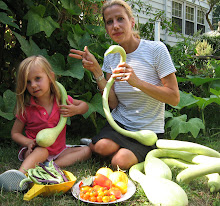
One fingerling potato went into the ground this spring. Sixty-Five came out this weekend. I am not kidding. Some are the size of golf balls, but most are quite sizable and eminently roastable with garlic confit and a crunch of sea salt. I’m salivating as they cure for a few days on the back porch.

The quantity simply blew me away. My daughter counted them out as we sat on the patio, enveloped by the flame sunset of autumn. The counting just went on and on, our eyes widening further at each turn of ten: 30, then 40, then 50, then 60 …

And thank goodness she came out to help. The roots and tubers spread into a circumference far beyond anything I would have expected. We kept digging, excavating, and finding more and more roots that wended their ways sideways in a starburst throughout the bed. Some roots were thick, some were spidery, but when we pulled them gently, guaranteed there would be more tubers greeting us at the ends.

The Earth gives and gives. One thumb sized fingerling yielded just so much. I saw firsthand why potatoes are a staple crop in the world, how civilizations have been built upon successful crops, and have fallen in their failure. The garden has given me a great deal this year, more so than in years past and not just in terms of crops. Add to that a new level of respect for Mother Earth – it seems in a way almost crass that I’m doing a running tally of monetary gains.

Suffice it to say, once the garden is put to bed, I can’t wait to start composting and amending her soil until a hard freeze, then commence again come spring. Dirty work it is, but it’s the least I can do.

Eco-Nomics:
Fingerling Potatoes: 9 lbs @ $.99 = $8.91
Butternut Squash: 24 lbs @ $.99 = $23.76
Tomatoes: 4 usable lbs @ $.99 = $3.96
Pattypan squash: 2 lbs @ $1.50: $3
Zucchetta Trombolina: 6 lbs @ $.99 = $5.94
Total: $45.57

Last Eco-nomics posting: $129.65
This harvest tally: $45.57
Ahead by a Total of: $177.22
“Whole Foods” Pricing: $x 3.5 = $613.27

Monday, September 14, 2009

It’s a Potato! It’s a Potato!

It was time.

Turning fork in hand, I headed out to harvest some russet potatoes. The vines of one plant had been declining slowly in recent weeks, and I’d been itching to dig them up. Oddly, my daughter was not so into it, “Nah, I don’t feel like it.” But once the messiness began, she got into the game.

I found the first potato close to the surface, where I’d been peeking at it and checking on it for weeks. It was about the size of an elongated tennis ball. I gently but deeply forked a wide area around the plant and brought up another little guy. My daughter was not impressed. The next forking brought up a monster: it was HUGE! Even I couldn’t believe my eyes. That’s when she ran to the shed, retrieved her Dora the Explorer hand-cultivator and got really into it, digging through the pile of loose soil.

What she got was a rock – which, upon realizing it, she tossed immediately into a side bed. We both persisted. She found another rock. So did I. I forked some more. Things didn’t look promising.

“Mom, I found one!”

“Is it a rock or a potato?”

She moved her hand up and down as if to check the weight. She wiped off some dirt with her little nearly-five-year-old thumbs. Her eyes widened to the size of saucers.

“It’s a potato! It’s a potato!” she screamed and squealed, running in circles, waving the spud over her head. I started laughing my head off at her reaction. Senor Wences got spooked, bolted out from beneath the hostas and made it to the other side of the yard like a bat out of hell. And she’s dancing around in a loop, squealing with a potato. Yeah, life’s crazy in the backyard.

We dug and checked as if panning for gold until I felt safe no more were in the area. I left the other russet and the fingerling plant undisturbed, as their vines are still green and, I assume, nourishing their tubers.

So, in this instance, one-half a spud thudded into the ground on a whim yielded eight potatoes – nice return! Two are huge, almost the length of my daughter’s head. The others are of varying, medium size, with one tiny pepino. One of the larger ones was damaged during the harvest, so we used it in our Sunday dinner, cut lengthwise and grilled with olive oil, garlic and fresh rosemary. It was pillowy soft, sweet and whiter inside than any russet I’ve ever prepared. Since the potato was uncured, its skin came off almost completely with just a gentle scrubbing.

In fact, everything we ate Sunday night came from our garden, except for the chicken. I gave the bone-in chicken a super-herb treatment with parsley, sage, rosemary & thyme (nod to S&G there), steamed a huge quantity of the purple beans, made “summer on a plate” with tomatoes of all colors and lettuce-leaf basil, and prepared the giant potato with a buttercup squash, which was also excellent: very orange, sweet and quite pumpkin-y.

So, let’s update Eco-Nomics. It was a banner week and weekend for tomatoes, with over a dozen pounds by Friday and another five picked on Sunday. Until the potatoes came into our lives yesterday afternoon, I planned on writing their own entry. But for now, I’ll just let the pictures and poundage speak for themselves.

Russet Potatoes: 6 lbs @ $.89 = $5.34
Tomatoes: 17 lbs @ $.99 = $17
Tuscan Kale: $4
Haricot Verts: 1/2 lb @ $2.49/lb= $1.25
Purple Pole Beans: 1 lb (probably our last) @ $2=$2
Green Beans: 1/2 lb @ $.99/lb: $.50
Pattypan squash: 4 lbs @ $1.50: $6
Total: $36.09

Last Eco-nomics posting: $97.56
This harvest: $36.09
Ahead by a Total of: $123.65
“Whole Foods” Pricing: $129.65 x 3.5 = $467.78

Monday, August 10, 2009

Pork, Peaches & Potatoes

I rarely, if ever, blog a meal. But the sun, the moon and the stars aligned on this one, from the ingredients to my timing on the grill.

It was a Saturday meal created after returning home from my daughter’s art class after four, and with Mike to return from work at seven. I served boneless pork marinated in a sherry vinaigrette with fresh sage, grilled peaches with balsamic vinegar and fresh thyme, and double-garlic potatoes, all with a salad that was freshly picked, just like the herbs.


I marinated the pork first and the peaches last, but started cooking the potatoes first, then the pork last. My timing blew me away as well – all three dishes were done to perfection and at the same time. When I got the Weber 3-burner grill early this spring, I loved it from the start and was ambitious from the get-go. First dish? Leg of Lamb, bone-in. I’d never owned a grill like this, only a charcoal kettle model, which I hated wheeling out, stoking, then cleaning later. But I’m a maniac with this one. From that first dish onward, I mentally vowed not to turn on my oven until Thanksgiving (except for baking), and there’s no need to: You can do everything on it. Try this:

For the Pork
4 lean boneless pork chops, 1” thick.
A dozen sage leaves, in a chiffonade
One small clove garlic, microplaned
Sea salt & fresh pepper
1 tsp sugar
Sherry vinaigrette (see below) plus extra sherry vinegar.

At least an hour before grilling, put a little smear of garlic on each pork chop, then marinate the chops in your sherry vinaigrette plus two extra tablespoons, salt, pepper, sugar and sage. Turn to coat during the course of marinating.
Grill 3 minutes, then turn 90 degrees and grill 3 minutes more. Flip over and finish to desired doneness. S&P the hot chops and serve.

Sherry Vinaigrette
4 T. sherry vinegar
¼ C. canola or other neutral oil
One small shallot, finely minced
1 t. Dijon mustard
1 t. sugar
S & P to taste.

Whisk together all ingredients to emulsify.
I had this leftover in the fridge from some salads last week and thought I’d try it as the pork marinade. I’m glad I did.

For the Peaches
Four large peaches, white or orange fleshed, cut in half and stone removed
2 T. balsamic vinegar
1 T. canola or other neutral oil
1 clove garlic, mocroplaned (optional)
1 T. fresh thyme, chopped, plus more for garnish
1 t. sugar
S & P
Butter (optional)
Chévre (optional)

Blend together the marinade ingredients in a shallow dish. Place peaches cut side down and swirl to coat. Grill over medium to low flame, rotating carefully to achieve good marks. Turn over, then dot tops with butter, if using. Cook to desired doneness. Plate, drizzle any leftover marinade over the top, and garnish with extra thyme, if desired. Serve with Chévre, if desired. Note: There are times I really like a lot of extra pepper cracked on top. Try it, you’ll be pleasantly surprised.

For the Potatoes
5 large potatoes, scrubbed and halved lengthwise
¼ C. olive oil or neutral oil if you prefer
3 large cloves of garlic, microplaned
1 generous t. sugar
2 t. sea salt
Fresh ground pepper to taste.

I came into a 5-lb bag of russets on Saturday for only $1.49 – not my favorite spud (as previously noted), but I couldn’t pass up the bag. Use any variety you wish. Combine all ingredients very well in a large glass bowl. Grill cut side down for 10 minutes, closing grill to use as an oven. Rotate 90 degrees and close grill for another 10 minutes. Turn over, grill for 15 or 20 mins more, depending on size of the potatoes. When the potatoes are done and still hot, place back into their glass bowl and toss to coat with the remaining garlic oil. Add extra salt, if desired. Garnish with chopped Italian parsley, if desired.

For timing’s sake, after flipping to the skin side of the potatoes, start grilling your peaches on the rear racks. Then move onto the pork chops over a high flame up front.

Friday, July 17, 2009

Eco-nomics: Harvest


It’s payback.

So far, I’ve harvested four armloads of Swiss Chard, and I’m not kidding about the word “armloads.” Holy mackerel. I’ll conservatively put each at $2.50, considering what $1.29/lb gets you at my supermarket. Some baby leaves have been making their way into salads all along. The chard is also just unbelievable: the colors are so bright, so varied and the volume speaks for itself. Just like “Cannoli 18 Ways,” I’m on my way to writing “Chard 118 Ways.” I love it, as does Mike, but we’re nearing overload. The next bale of greens has my father’s name on it.

I’m also up to my ears in cucumbers, which seem early to me this year. We’ve picked at least a pound of kirbies, which barely make it to the table. My daughter eats them straight off the vine – she goes hunting for them, actually. I’m glad I tried something new this year and planted them! The lemon cucumbers are coming in like gangbusters. I’ve picked a few here and there, but come next week, there are at least a dozen that will be ready. Each time I look at the vines, I can’t believe my eyes. I’ll tally those at that time.

The little filet beans are early producers, and at least a pound have come off the vines. They are delicate and sweet, and even the ones that elude us and grow too long are super tender as well. A lot of these little beans go into a pound. If I let them grow larger, the harvest weights would be higher. But I grew these to be picked small. Next time I come into some good tuna steaks, a salad nicoise will be in order, and especially when my fingerling potatoes are ready in the fall.

A big surprise is the Kwintus pole beans. I was not expecting these to come in so early, but MAN – do those vines produce! The beans also grow fast. Those left on the vine for an extra day jump out at you the next, reaching eight inches seemingly overnight. And even at that length with a 1” width, they are tender and stringless – excellent cut on a diagonal and steamed, sautéed or tossed into a hot sausage and peppery pasta dish like the one I made last week for my husband. The beans keep their crunch and their color beautifully when cooked. Plus, we’re up to almost 2 lbs picked. I gave a bag of them to my parents this weekend, with rave reviews when they cooked them. I’ve never seen these at the store, so I’ll just price them as regular green beans, which are $1.29/lb lately.

Volumes of tender green small leaf lettuce along with two very large heads of red loose leaf lettuce have created some great salads. I would easily have spent more than $4 for this at the store – quite a nice return on that impulse buy of two 20-cent seed packets! I can’t wait to plant more in the fall. The lettuces are in pots, so the rabbits haven’t marauded them. The same can’t be said for my four heads of cauliflower. Only one made it to full size and to the table.

We’ve also pulled a few red carrots, but I feel they need a bit more time in the ground. The one pattypan squash picked made its way to the grill – de-lish. Neither is really enough to tally right now, so I’ll omit them.

So, here goes, the first Eco-nomics Harvest Tally:

Chard: 4 @ $2.50= $10.00
Kirby Cukes: 1 lb @ $.99/lb (Shop Rite price)= $.99
Haricot Verts: 1 lb @ $2.49/lb= $2.49
Kwintus Beans: 2 lbs @1.29/lb = $2.58
Lettuces: $4.00
Cauliflower: $1.50
Total Harvest so far: $21.56

Total Expenditures: $49.70
Less Harvest: $21.56
Balance: $28.14

I’m still in the red, so to speak, but we’re getting there. And pretty far along at that.

Thursday, June 18, 2009

Pork and Prune Sausage

A few weeks ago, I posted my musings on making Merguez after reading a sausage article in the Dining In section of The New York Times. Well, I didn’t stop at Merguez. I made the Pork and Prune sausage that night as well and further stocked the freezer.

The ingredients reminded me of a fruit-stuffed pork loin I make with garlic, thyme and Madeira – which is the treatment I adapted when preparing them a few nights ago, as written below. For now, here is the recipe from The Times:

Garlicky Pork Sausage with Red Wine, Prunes & Rosemary
From Melissa Clark

¼ C. diced prunes
2 T red wine *
1 lb ground pork
2 garlic cloves, minced (I microplaned)
1 T finely chopped shallot *
1 ½ t. kosher salt
1 t. ground pepper
1 t. minced fresh rosemary
Finely grated lemon zest

In a large bowl, mash together the prunes and wine. Add remaining ingredients and combine well. Put into casings or shape into patties, or as desired. Chill, freeze, or use immediately.

* I added extra fruit to the mix, and substituted Port for the red wine, macerating the prunes for a considerable length of time. They really plumped up. I also had good, sweet shallots on hand, so very finely minced them and added more. Be generous w/the rosemary, too.

One-pan dish
My husband often works nights, so bringing a dinner is usually requested – it’s more economical and he says it’s better than most options for ordering in, such as greasy Chinese or “gut-buster” (his words) Mexican. So, one night, at a loss for leftovers and far too late to cook a full soup-to-nuts dinner, I reached into the freezer for the pork & prune sausage, taking an extra one to sample myself. They thawed very quickly, and I sautéed them in a pan with some garlic, fresh thyme sprigs, peach wedges and a pair of Yukon Gold potatoes, halved, removing each element as it was cooked through. I then deglazed the pan with some port (as I’d used in the sausage), added fresh thyme and drizzled the sauce over the meal. A few generous grinds of cracked black pepper and it’s just how Mike would like it.

Saved yet again by a well-stocked freezer (!)

Even with the peaches, the flavors were decidedly autumnal, so I’ll likely be saving the sausages for then. At that time, I plan to cook them on the grill along with seasoned apple halves and potatoes – or with peaches again, if the fruit is still good. Caramelized grilled peaches sprinkled with thyme are a true treat. And hopefully, the potatoes will be fresh-dug from the garden!

Thursday, June 4, 2009

June is Bustin’ Out All Over

Bustin’? Well, that remains to be seen. But at least it’s off to a good start. Sprouts are sprouting, plants are planted and vines are twining. But my level impatience this year seems higher than ever, if that’s even possible. Here we go, from bed to bed, front to back:

The patch of corn with sunflowers rising in the background is off to a good start. I staggered the planting this year in hopes that the harvest will be spread out over a few weeks.

Red carrots and Swiss Chard varieties are clipping along in the small bed that lies astride the garage. Christmas lima beans and Kentucky Wonder green pole beans are planted to climb the trellises we built last year. It’s hard to believe this small bed used to be my sole planting area.

Lettuces are growing pots, as is my thyme plant. I moved my radicchio to one of the pots from a ground bed due to rabbits. The thyme will be planted on the rim of the main beds, along with a division of my oregano, when I both remember to do it and find time. An impossible combination.

Squash bed (1st/smallest): Winter squashes in alphabetical order from front to back, Buttercup, Butternut and Delicata. The last, large double-mound contains pattypan squash. Three climbing Zucchetta Trombolina plants are near the rhubarb in a corner of the yard.

Middle bed: Lemon cucumbers and Kirby cukes are ready to climb the staked twine. The kirbies also have flowers.

Tomatoes: Area is packed full, but plants are small. Why? I have no idea. The soil was pre-warmed, which made them shoot up and produce early and prolifically last year. But considering the size of the plants, I think I could have just skipped the mess, series of incidents and ensuing drama of starting them indoors and instead, direct-sowed the seeds with the same plant size resulting. Such is life. It’s only the first week of June. There’s time. I like to think each little tomato plant is developing a huge set of roots underground, where I can’t see. I attempted to plant them in backwards-alphabetical order starting with “Y”, but that lasted for only 1-½ rows. When I planted the Black Cherry tomatoes (or Black Russian?) before the Sungold Cherries, I wasn’t about to take them up and start over. I figured I’d just remember which was which. [What was I thinking?] I know where the heirloom yellows and two San Marzanos are. The rest will tastily surprise.

The largest bed starts with watermelon radishes and four cauliflowers. Believe it or not, the three little ones have white cauliflowers growing inside – at a competitive size with that of the large-leaved plant. Behind those, you’ll find the beets. No, I don’t see them either. I have a confession to make: I’m an inveterate bad-waterer. Notice the soaker hoses I bought and put down just this weekend. Thought it was about time. A top dressing of composted leaf humus will be the finishing touch.

Yellow bell peppers, one purple pepper and Rosa Bianca eggplants doing all right. Common basil and lettuce leaf basil in the center of that bed. You’ll also see four celery plants, which I purchased for $2 at the farmer’s market. They don’t count toward the running total, or to the harvest tally. It would be impossible to calculate, since I pick the celery constantly and the stalks regenerate themselves during the summer. It’s a terrific thing to grow for that purpose, since I only need a stalk or two for a grain salad or other dish, hardly ever an entire bunch. Also, hot chili peppers – a pair of plants I found at that bastion of green, the Home Depot. I found a pot that had two tall, strong plants, so I couldn’t resist. My dad (and father-in-law for that matter) can’t wait for them.

Pole beans are also planted in alphabetical order from front to back: Emerite filet, Kwintus and purple-podded. I love garden beans. They’re easy and dependable. Just have your four-year-old poke her finger into the soil, drop the seeds in, and soon enough they’re all vining and twining their way up the poles. The three tee-pees will be just gorgeous once the plants fully cover them and start to flower.

Celery Root surviving. And …

Potatoes! Two russets and a fingerling plant. I can’t believe it! Those spuds I thudded into the ground came up! The plants are strong and actually quite attractive. I had chalked them all up for lost, since our black and white cat, Senor Wences, found the loose and deeply dug soil irresistible for digging and rolling. They truly appeared out of nowhere. The russets surprise me the most, since they were supermarket potatoes from a 5-lb bag, and were probably sprayed with an anti-sprouting agent. Two of two came up. The fingerlings came from potatoes purchased at Whole Foods, labeled organic, and I assume not sprayed with anything. Only one of three came up. Either way, the plants appear to be growing fast, and they are sturdy. I’ve never grown potatoes before and I’m excited to watch them.

Whew! That got long. Maybe June is bustin’ out all over.

Monday, May 11, 2009

Planting Party

It was a happy Mother’s Day. A crisp-breezed, blue-skied, birds-chirping, muddy, grubby, dirt-under-your-fingernails Mother’s Day.

We planted seeds and seedlings all afternoon.

The day started with a brunch at my mom’s townhouse and a stop on the way to purchase a floral hanging basket for her. My daughter and I went to a local nursery and farm where I also picked up a 4-pack of yellow bell pepper seedlings for $1.79. The plants looked terrific, and I’m happy to support that nursery and farm. It’s a small but longstanding business in competition with not one or two but three Home Depots in Bergen County, in addition to a Lowe’s that opened last year.

Plus, the excitement and prospect of planting them that afternoon made me stop by on the way back from my mother’s. I purchased a 4-pack of Rosa Bianca eggplants and a 3-celled pack of Kirby cucumbers that contained six plants.

Once home, my daughter and I got down n’ dirty, building the pole bean teepees and erecting a cucumber contraption we constructed from twine and some old garden edging we found in the shed. We cut holes in the plastic sheeting I’d applied weeks ago to pre-warm the soil, measured, dug, spaced, sowed, planted and watered for much of the afternoon, with, to my memory, just a few breaks: a game of tag, a change from soaked shoes to dry (hers), a change from a soaked dress to dry jeans (ditto), one stop to make a peanut butter and birdseed sandwich to fit into the suet feeder, another to make a peanut butter sandwich for the humans, the unraveling, re-raveling and unraveling yet again of the entire spool of twine, two glasses of pink lemonade, playing with the cats underfoot, an incident involving two bottles of bubbles – it’s a wonder we got so much done!

What’s in the ground now, coded with an S for “from seed” and a P for “purchased plant”:

Tuscan Kale and white cauliflower (S)
Watermelon radishes, Detroit red beets, golden beets (all S)
Radicchio (S) – my cats are not fending off the rabbits there.
Red Carrots, Rhubarb Swiss Chard & Rainbow Swiss Chard (all S)
One row of corn (S) – two more to come over the next two weeks.
Pole beans: Kwintus, Emerite Filet and Purple Podded (all S)
Winter squash: Butternut, Buttercup and Delicata (S)
Pattypan Squash (S)
Yellow bell peppers (P)
Rosa Bianca eggplants (P)
Lemon cucumbers (S)
Kirby cucumbers (P)

While we were at it, I tossed in three fingerling potatoes that had sprouted in the kitchen, plus a Russet that I cut in half and scabbed over. They went in just around the outer rim of the largest bed. We’ll see what happens there.

Tomato varieties (all S) and celery root (S) are going in soon. Zucchetta Trombolina and Christmas Limas (both S) will have to wait a week more. I didn’t pre-warm that bed.

In hindsight, I’m glad I bought the seedlings this weekend. I felt as if I were cheating in some way, but geez, do I have square footage to fill! After cramming crops into two very small beds near the house for years, I’ve realized that I need to reformulate my mental proportions. The area I ripped up last fall for gardening can hold a lot more that I’d thought.

So, let’s add Sunday’s expenditure to the tally. I had figured early on that only seeds would be part of my Eco-Nomics experiment, but I may as well add the purchased plants. It’s just $5.37, and including it in the running total will make harvest calculations that much easier.

Past total of Seeds,

Peat Pellets, other: $44.33
New Plants: $5.37
Total: $49.70

Friday, February 27, 2009

Grains I


Dinner in question, if you will? When in doubt, consult the sill.

The windowsill, that is.

I love grains, lentils and similar dry goods bought pre-bagged or in bulk. They’re cheap, they keep, they’re healthful and their possibilities are seemingly endless throughout the year. Need a side dish? You could eeny-meeny-miney-mo my windowsill for something new every time. Looking for a side salad? Put on your blindfold and reach into the overflow bag-o-beans and grains in the pantry.

In the winter, a warm pilaf of barley and rice, or rice with lentils, or, as below, lentils and barley is warm, hearty, healthy and delicious hot or at room temperature the next day for lunch. During the summer, a salad of fresh-picked vegetables and handfuls of herbs from the garden tossed with couscous or steamed buckwheat with a touch of lemon juice can be assembled in no time with incomparable freshness and flavor.

My standard windowsill set from left to right: long grain rice, polenta, French green lentils, barley, Arborio rice. In the summer, the far left empty jar is filled with fine couscous and the Arborio rice is replaced with wheat berries.

Also included in the grain larder (i.e. a big ZipLoc bag on the lower right shelf of a cabinet): farro, buckwheat groats, brown lentils, red lentils, split peas, all manner of dried beans, plus overflow for the windowsill jars and likely a few that I'm forgetting, or will find as a surprise whilst digging.

The other night, I put the French lentils to good use with an idea I’d had during the week to stretch the leftovers from a large roasted chicken. The meat was more like a garnish, which was my intent.

1 C French lentils du Puy
½ C pearled barley
1 C chicken stock
½ C water, or as needed
2 shallots, halved and thinly sliced
1 clove garlic, smashed but in tact
Thyme sprig(s)
2 good-sized potatoes of your choice, peeled and cut into a ½ to ¾ inch dice.

Sweat the shallots low & slow until they are very soft, golden and very sweet in butter, canola oil or a blend of both, with thyme and garlic added midway. Add lentils to pan, stir to coat. Add barley, stir to coat. Add S&P. Deglaze with a good splash of sherry (I used Amontillado). Once sherry evaporates, stir in stock and water. Bring to a bare simmer. Cover & cook for about 20 minutes, checking occasionally for dryness. Add water if needed, and re-cover.

Meanwhile, heat your choice of lubrication in a sauté pan. **Note: I had bacon fat in a small sauté pan left over from the morning and used that. I saved the drippings specifically to use in this dish. I recommend it here.** Toss in potatoes and brown on all sides. Salt generously to taste when they are cooked through.

Retrieve garlic clove and thyme sprig(s) from the lentil-barley mixture. Gently fold the potatoes through the pilaf to combine. Garnish with fresh chopped Italian parsley. S&P to taste. Stir to combine. If desired, slice and fan chicken over the lentils and sprinkle the meat with a good Sherry vinegar. Serve with salad and crusty bread with warm garlic confit. Serve same for lunch the next day [shown left, as taken to work], refreshing the parsley and vinegar, if desired.

Sunday, February 15, 2009

Kidneys

I’m not quite Fergus Henderson, but some of the best-tasting stuff - organs, blood, guts, tails and entrails - truly go to waste in this country. At least I’m not alone in this thinking in my household. My four-year-old daughter and I battle it out for the last piece of liver – any kind: chicken, turkey, calf or duck (she’ll stab your hand with a fork if you even try to reach for that one).

This started with the first Thanksgiving that she was eating solid food. At the tender age of one year and two months, she decimated the turkey liver all on her own. I look forward every year to that turkey liver. Until she’s married and on her own, I don’t think I’ll ever be able to have it again.

My husband prefers to take a pass on organ meat, mainly due to his concerns over cholesterol. So I don’t serve it too often. But when Mike works late, I’ll make a mess of hearts and gizzards for my daughter and me to “share” – you can guess who powers down the most. When we roast a whole chicken, we cook and eat the contents of the inner packet before we even season the bird. Or I’ll get a small but thick slice or two of calf’s liver for us to cook perfectly pink with juices running. Ketchup? Never. She’s a purist and takes it straight.

So when I saw a pair of veal kidneys glistening and fresh, I couldn’t pass them up. And the price? The butcher was giving them away.

Lightly browned then kept warm, the kidneys were served with a pan sauce of butter, shallots, white wine and a whisk of Dijon mustard. How could you go wrong? Apparently, I did.

“I just passed a stone, and you’re serving me this?!?”

That part was true. Mike had had a really rough go of it, but two weeks had passed [term intentional] since the stone did. I suppose it wasn’t quite enough time.

He made a go of it, though, in part because I think the sauce was so good. But I could tell he was straining a bit at the table.

My daughter, however, was on the verge of licking her plate clean.

“May I have some more, please?” she said at least three times, reaching for the serving platter.

“She loves organ meat,” Mike kept saying, as she shoveled it in and I passed another slice to her.

In the end, I gave Mike a pass, too. “Just swirl the potatoes in the sauce,” I said, which he did, with relish. And we had a good laugh about it later.

Rognons de Veau a la Moutarde
Thank you, Anthony Bourdain.

2 whole veal kidneys
S & P
1 T Vegetable Oil
2 T butter
2 shallots, thinly sliced (more if you like sweet, sweated shallots)
¼ C. white wine
½ c. chicken stock
2 T Dijon mustard.

S/P the kidneys and sauté in the oil and 1T butter. Cook 2 mins per side. Set aside and keep warm.

Discard the fat from the pan, add the rest of the butter and cook the shallots until soft. Deglaze with the wine and reduce by half. Add the stock, bring to a boil, and cook for 5 mins. Whisk in the mustard.

Slice the kidneys, arrange on a platter and spoon the sauce over them.

Wednesday, January 14, 2009

On Potatoes.


That $1.29 5-lb bag of Eastern White potatoes got me thinking about potatoes in general. Over the past few years, I seem to have become a potato person. I never thought this would happen.

True, potatoes can be a cheap and dependable carbohydrate for meals, but that’s no reason to simply consume them. They store well and keep, vary in taste, size, color, and texture and are infinitely useful. The Incans cultivated many hundreds of varieties adapted to both varied sun conditions and terrains, up and down the sides of the Andes. But I never really ate potatoes before. Maybe it was the “fattening” [untrue] rep they had? My grandmother ate potatoes with dinner every single day of her life and lived to 92. Maybe a nascent gene from the Polish side of my family is surfacing? Either way, I’m a convert now.

However, Eastern Whites are not usually my first choice for potatoes. But at less than 26-cents per pound, I was not passing up that bag. In fact, I went back at the end of the week for a second bag (there was a limit of one per store visit.) At that price and with that quantity on hand, I didn’t feel so guilty about the waste incurred while I practiced “turning” potatoes for Pommes Fondant [potatoes sautéed in duck fat w/thyme.] Really? You have no duck fat stored in your freezer? You should. I certainly hope you didn’t waste any of that rendered liquid gold left over the last time you roasted ducks for a party of 12 … but I digress.

These Eastern Whites are fairly basic spuds. They could have been any of a number of varieties. The bag listed Maine as their place of origin, so they were probably MaineStays: a high yield, late maturing type with white skin and white flesh. I chunkily cubed two huge ones last night and dropped them into a pot of vegetable soup. I steamed a number of small ones and tossed them with butter, salt and parsley as a side dish with broiled bone-in chicken. They were OK, serviceable. I would not roast them; the moisture content is a bit high and they don’t caramelize that well (I’ve done it before). I’m sure they’d be about OK to mash. But again, not my first choice for that preparation.

My faves? Well, that all depends on what you’re doing with them. Here are my thoughts on a scant few varieties:

All around goes to Yukon Golds. They’re widely available, good with the skin on or off, good large or small, and flavorful all on their own. I’ll use these for any dish. Unpeeled: They’re unbelievable cut as steak fries and roasted with a ton of garlic and sea salt. Great quartered and roasted with fresh rosemary and other root vegetables. Excellent baked like an Idaho, since the golden interior already is like butter – but please, do feel free to add more. Peeled or unpeeled: steamed then sliced warm over a salad. Peeled: Great peeled and steamed – my favorite potato with steamed sweet potatoes in a Sherry vinaigrette with fresh sage leaves that I make, eaten hot, warm or cold. Sliced for scalloped potatoes, they’re already creamy and buttery. Diced for potato salads with all fresh summer ingredients. Try these for latkes. And of course, mashed. Yukons end up golden and creamy like nobody’s business.

Purple. I love these, not only for the color. Roasted, skin on: very good, nutty but sweet. Steamed, quartered w/butter: very good. Sliced warm on a salad: ditto. Small purples, Red Bliss and Yukons together on the grill for Red White & Blue potatoes on the 4th of July. Try to find smaller ones. Fresh only, please. Make sure the skin is smooth and taut. These can be pricey if you can find them, so buy only good ones. Once they shrivel, the taste (and cooking results) seem to go south. Easily a dozen blue/purple varieties. What you probably find is the “All Blue,” although you may find true Peruvians if you’re lucky. I plan to grow a type of blue this summer.

Fingerling. Nutty, golden, delicious. Useful. Shapewise, can be amusing. Can be pricey. Keep the skins on and roast with entire heads of garlic. Then squeeze the garlic cloves out of their paper, toss with the fingerlings in a large bowl and sprinkle liberally with sea salt. Oh yeah, delish. Excellent sliced warm over a salad, and don’t forget the bacon. Many, many varieties. What you find is likely “salad fingerlings.” I plan to grow Russian Banana fingerlings this summer.

Red Bliss or “New” Potatoes. The only kind my mother buys, I’m not as big a devotee. But please, keep the skin on. Small, round baby ones are good to roast with rosemary. You can’t go wrong with reds if you’re doing a clambake or lobster boil. Some people like them mashed, skin on, for “dirty potatoes,” but I find the moisture content too high for uniformly good results. Good for summer potato salads. Good with lemon and fresh parsley, too.

Russet Burbank. America’s spud. Actually, Russets account for 40% of U. S. potato growing acreage. All around useful and available everywhere. French fries, boiled, baked, roasted, hash-browned, mashed. Soups, stews, pot roasts. But to me, they’re just baking potatoes.

Friday, January 2, 2009

Canadian Bacon & Eggs


January 2, 2009.
I didn’t want to just divulge every little habit or hobby from the start, but I found something during my bag-of-potatoes foray on Sunday: a list.

I collect grocery lists. Well, I don’t usually keep them, at least for long, but I love to read them, construct the life of the writer and figure out what he or she was going to cook. The lists can be bizarre, or the game can be quite easy. But it’s always fun and interesting. The $1.29 potato special apparently jumped off the circular page for this list writer too, a woman. Believe me, men’s lists are identifiable, and this wasn’t one of them. [More on that later.]

Her list was short and sweet, with just three items: “eggs, bag potatoes, can. bacon.” But Oh, what was going to be made with them … at least I knew exactly what I would do with them:

Warm your oven to 200 to 250 degrees.

If not already sliced, cut your Canadian bacon into the desired number of slices (or slabs), setting aside a remaining amount to dice.

Peel (if desired) as many potatoes as you want, then slice them into disks. Set aside in a deep bowl.

In a large bowl, whisk as many eggs as you need. Add some milk to lighten the mixture and whisk again.

Heat a heavy skillet or deep cast iron pan over medium heat.

Melt a good knob of butter in the pan, being careful that it doesn’t scorch. If it does, lower your flame and start over. Canadian bacon is lean (really, it is), so you need a little lubrication. Use a blend of butter and Canola oil if you fear a cholesterol bomb. Then again, if you do, why are you making this dish?

Cook the sliced Canadian bacon in batches to avoid overlapping. Once the edges are golden brown and caramelized, place on one side of a large, oval platter, cover with foil, and place in the warm oven.

Salt and pepper your potatoes, tossing with your hands in the bowl to evenly coat. Lube your pan some more, and don’t be stingy. This is where some variations can begin:

Sauté the diced Canadian bacon in the pan with a sprinkle of sugar. Or caramelize some thinly sliced onions, if that’s the direction you’re taking. Add minced garlic if you’d like. Either way, you’re starting the potatoes. Keeping them plain is very good as well. Toss them into the same pan.

Let them sit and sizzle a bit to form a crust on the bottom potatoes. Gently agitate the pan, then flip the potatoes over. Let the top ones form a good crust now that they’re on the bottom. Continue this process until they’re crispy, browned and just about cooked through. Re-season to taste and place in a covered serving dish or casserole and place in the warm oven.

Re-whisk your eggs to lighten and add air. Make sure the pan is not too hot. And that’s ALL you are to do to the pan: do not wipe it, do not scrape it, do not empty it, do not even breathe on it wrong. Everything you want is now stuck to the bottom.

If you didn’t use it in the potatoes, add the diced Canadian bacon to the pan with a little more butter. Sauté until sweet and caramelized, then add the eggs to the pan. Salt & pepper the eggs to taste. Scramble to desired doneness with a flat-edged wooden spatula.

Place the eggs on the open half of the oblong platter holding the warm Canadian bacon slices. Serve with the warm potatoes from the oven. Feed the crowd some fruit salad or melon wedges to assuage the guilt. Top with a Bloody Mary.

Tuesday, December 30, 2008

Inventing a Soup

Sunday, December 28, 2008.
I know it’s just days past Christmas and how could I think about food?!? Well, first, I’m half-Italian by heritage, so that’s pretty much all we think and talk about. Second, I love to cook, bake, experiment, and create something from nothing – a point of pride at times, and at others, a necessity. But today, I’m mainly thinking that I have work hours on Monday, and if I don’t have things made and clearly labeled throughout the refrigerator and on the countertop for the days my husband is home, it will be determined that there is “no food in the house,” or “nothing to eat.” I don’t know why that is. My four-year-old daughter is off from pre-school this week as well, and believe me: I don’t want them subsisting on Cheerios, which is what would happen unless an elaborate spread is in plain view.

And anyway, I’m a circular junkie, and the Sunday paper brings a pile of them. I always seek out the ShopRite circular first, and today I need to stop there with my daughter in tow for milk and dry cat food. Maybe there’s something on sale that I could use, or that at least could give me an idea. Bingo: a 5-lb bag of Eastern potatoes is $1.29, limit one with PricePlus. We’re as good as there.

My daughter loves to help and I prefer to include her in the kitchen. She is very skilled already, and can be quite a taskmaster when I’m taking a shortcut, skipping a step or chopping versus mincing (i.e., I’m tired, but she can tell when I’m being lazy with the shallots. And she’ll holler at me for it!)

So, with the $1.29 bag of potatoes, basic pantry and fridge items and our homegrown zucchini [zucchetta trombolina, not the “usual” green summer squash – more on crops and gardening later] from the freezer, this is what we made:

2T unsalted butter plus 1T to 2T good olive oil
4 shallots, minced
6 medium to large potatoes, peeled and diced to ½”
Zucchini, quartered and chopped, about 3 cups
3C chicken broth (regular or low sodium canned is fine; stock may be too heavy for this)
3C water
sea salt and fresh ground pepper
2 eggs, beaten very well in a deep bowl
good handful of Italian parsley, chopped fine. Include some stems.
Juice of ½ a lemon

Over medium heat, melt the butter with the olive oil and sweat the shallots until they are golden and fragrant.

Add the potatoes and stir to coat. Agitating occasionally, cook for about 5 minutes to impart the sweet shallot flavor to the potatoes. Toss in about ½ t. sea salt and a dozen grinds from the peppermill. Cook for another few minutes, then add zucchini and half the parsley. Combine and cook for another few minutes.

Add broth then water, stir, bring to a simmer.

Once simmering, very slowly ladle a portion of broth into the eggs, whisking constantly [to temper them]. Add a second ladleful in a very slow stream to the eggs, whisking constantly. Add a third in the same fashion. Whisk this egg mixture slowly back into the pot, blending fully.

Stir in the lemon juice, cover and cook for 20 minutes, or until potatoes are done.

Using a ladle, scoop out mostly potatoes and broth, enough to fill a blender. Puree on high, then return the pureed portion to the pot. The resulting soup will have texture and chunks, with much of the zucchini in tact. If desired, repeat to blend the entire pot. If you have an immersion blender, process to your desired consistency.

Add the remaining fresh parsley, then salt and pepper to taste. Finish with a pat of soft butter, stirring to combine all.

Serve topped with good Romano cheese finely grated on a microplane, or with a lemon wedge on the side and additional chopped fresh Italian parsley, depending on how your tastes run.

My husband liked it both ways: fresh and lemony, and salty and savory with the Romano. I floated a handful of drained, rinsed Cannelini beans on top for my daughter, who went heavy on the Romano, her favorite cheese. [More on her tastes later, too.] I rounded out their lunches with crusty, super-toasted semolina bread with my garlic confit [a future entry] and the option of a turkey sandwich.

The soup was good – not quite Vichyssoise, not quite Italian Wedding soup, but using some of the principals and some of the ingredients of both. Plus, it barely cost $1.50 to make, and I still have more than half of the potatoes left.

So, there it is, my first entry. This is who I am, and this is what I do, or at least part of it.